The Civil Service Situational Judgement Test (SJT), sometimes called the Management Judgement Test at senior grades, is one of the more misunderstood assessments in the recruitment process. Unlike the Verbal or Numerical Reasoning tests, there is no single correct answer derived from logic or data. Instead, you are being asked to demonstrate how a capable, values-aligned civil servant would respond to realistic workplace situations.
Candidates who approach it as a trick question test, or who try to second-guess what they think the assessors want, typically score lower than those who engage with each scenario genuinely and think about what good professional judgement actually looks like.
What the Test Is Actually Measuring
The SJT is designed to assess your alignment with Civil Service values and your practical judgement in workplace situations. Every scenario has been developed and tested against the judgements of high-performing civil servants at the relevant grade. The "correct" answers are not opinions; they reflect a consensus view of effective professional conduct.
The core values running through the test are: integrity, honesty, objectivity, and impartiality. Beyond values, the test looks at whether you understand when to escalate, when to act independently, how to manage relationships, and how to balance competing priorities without cutting ethical corners.
The Two Question Formats
The format you encounter depends on the grade you are applying for. At junior grades (AO to EO level), you will typically be asked to rate each response option individually, usually on a scale such as Very Effective, Effective, Neither Effective nor Ineffective, Ineffective, or Very Ineffective. Each option is assessed on its own merits rather than relative to the others.
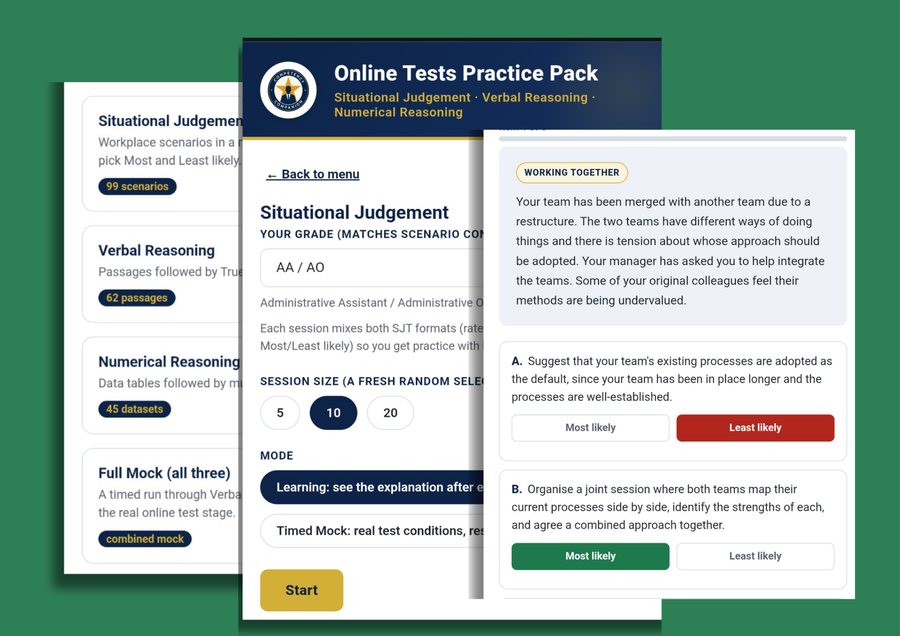
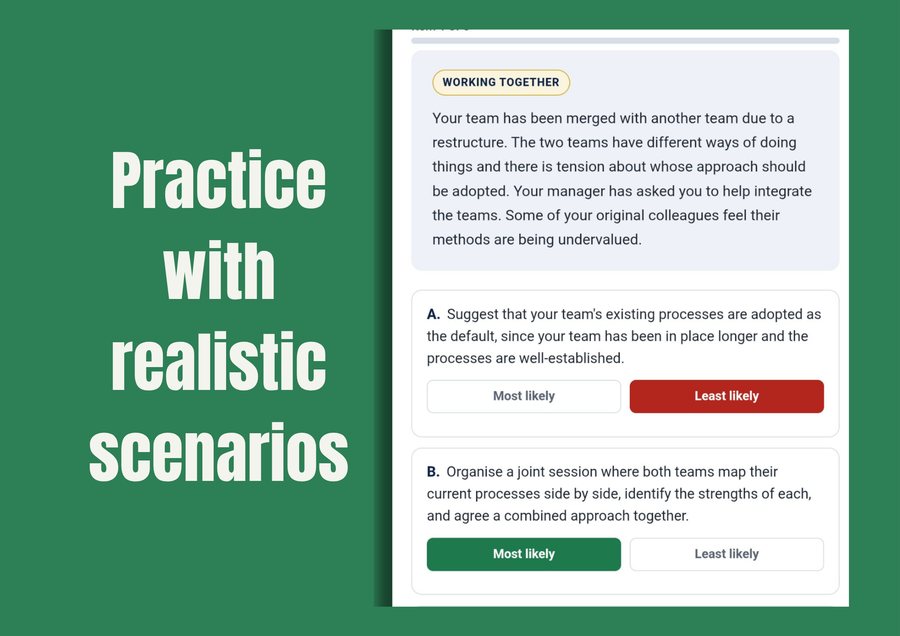
At senior grades (SEO and above), the format shifts to a Most Likely / Least Likely approach, sometimes called the Management Judgement Test or CSMJT format. You are presented with four response options and asked to identify which you would be most likely to do and which you would be least likely to do. This format is more demanding because it forces prioritisation: two of the four options might both seem reasonable, but you must commit to a ranking.
In the Most Likely / Least Likely format especially, the options are carefully constructed so that surface-level reading can lead you to select an option that seems reasonable but is actually the least effective. Always read all four before committing to either selection.
What Good Judgement Looks Like
Across both formats, certain principles consistently separate high-scoring responses from lower-scoring ones. High-scoring responses tend to: address the root cause of the situation rather than a symptom; respect appropriate lines of authority while still taking responsibility; involve or inform the right people at the right time; and avoid either doing nothing or acting disproportionately.
Low-scoring responses typically fall into one of a few patterns: going above your authority without good reason, remaining passive when action is clearly needed, prioritising your own comfort over the organisation's interests, or handling sensitive situations in a way that creates further problems.
Candidates often select responses that sound impressive: taking bold unilateral action, confronting problems head-on, escalating immediately to senior leadership. These responses can score poorly if the situation called for a more measured approach first. The Civil Service values considered, proportionate responses. Heroics without consultation are rarely the right answer.
Ethical Dilemmas and Integrity Questions
Many scenarios involve a tension between doing what is convenient and doing what is right. A colleague has cut a corner. A manager has asked you to do something that feels uncomfortable. A stakeholder is pressuring you towards a particular outcome. In every case, the test is checking whether you will maintain your integrity under pressure.
The answer in these scenarios is almost never to ignore the issue, and almost never to escalate immediately to the most senior person available. The expected response is usually to raise the concern through appropriate channels, starting with the most direct and proportionate route.
Managing Up Effectively
A significant cluster of SJT scenarios involves communicating upwards: telling your manager about a problem, a risk, or a disagreement. The Civil Service places high value on people who keep their managers informed with accurate information, who surface risks early, and who come with solutions rather than just problems. Scenarios that require you to choose between keeping quiet and flagging an issue almost always reward flagging, but how you flag it matters.
When a scenario involves a problem or risk, responses that both inform the relevant person and propose a solution or way forward consistently score higher than responses that only do one or the other. Flagging a problem without a proposed path forward can seem passive; taking action without informing anyone can seem presumptuous. Both together is usually the most effective response.
Practising Effectively
The most useful preparation is working through realistic practice scenarios and then studying the rationale for each answer, not just whether you were right or wrong, but why the recommended response scores higher. Over time you build an intuitive sense for what the test values, which makes the real assessment feel much more familiar.
Avoid simply memorising answer patterns. Scenarios vary considerably, and a mechanical approach will not transfer well. The goal is to internalise the underlying principles so that you can apply them flexibly to whatever situation the test presents.
What Comes After
Passing the online tests (whether Verbal Reasoning, Numerical Reasoning, or the SJT) takes you through to the sift stage, where your written behaviour or competency examples are assessed. This is typically the highest-attrition stage in the whole process, and where targeted preparation makes the biggest difference.