The Civil Service Numerical Reasoning Test (NRT) is one of the most commonly used online assessments in the recruitment process. It is not a test of advanced mathematics. It is a test of whether you can read data carefully and perform straightforward calculations accurately under a small amount of time pressure.
Most candidates who fail do not fail because the maths is too hard. They fail because they misread the data, pick the wrong row or column, or lose time by approaching questions in the wrong order.
What the Test Actually Involves
You will be shown a table, chart, or graph (sometimes a combination) and asked a series of multiple-choice questions based on that data. The calculations themselves rarely go beyond percentages, ratios, and basic arithmetic. A calculator is usually provided.
The challenge is not the calculation. It is finding the right numbers in the first place, and not being caught out by questions that look simpler than they are.
Read the Data Source Before the Questions
Before you look at any of the questions, spend fifteen to twenty seconds studying the table or chart. Identify what each column and row represents, check the units (thousands? millions? percentages?), and note any footnotes. This investment pays back immediately: you will navigate to the right figures much faster when answering.
If a table shows figures in thousands and a question asks for the answer in millions, candidates who skip the units check will be off by a factor of 1,000. Always confirm the unit before you calculate, and check whether your answer needs to be expressed differently from the source data.
Percentage Change Is the Most Tested Calculation
The single most common question type across Civil Service numerical tests is percentage change: what is the percentage increase or decrease between two figures? The formula is straightforward: subtract the original from the new figure, divide by the original, and multiply by 100. Know this formula without having to think about it.
The trap version of this question presents you with the percentage change and asks you to find the original or final figure. Work backwards: if a figure increased by 20% to reach 600, the original was 500 (600 ÷ 1.20). Practise both directions.
Ratios and Fractions
Questions involving ratios typically ask you to divide a total in a given proportion, or to identify what fraction one figure represents of another. Both types are straightforward if you slow down and read what is being asked. Candidates lose marks here by rushing and dividing in the wrong direction.
Questions often include more data than you need. A table with six columns and eight rows might only require two of those figures to answer the question. Candidates who try to use all the visible data, or who assume the most prominent figure is the relevant one, frequently pick the wrong answer. Read the question first, then go to the data.
Time Management
If the test is timed, work through questions at a steady pace. Do not spend more than a minute and a half on any single question. If you are stuck, make your best estimate and move on. An unanswered question scores zero; a considered guess gives you a chance. You can often eliminate two or three of the five options quickly by checking whether the magnitude of the answer is plausible.
Where a calculator is provided, use it consistently rather than trying to do arithmetic mentally. Mental arithmetic under pressure introduces errors that a calculator eliminates entirely.
Practise With Real Data
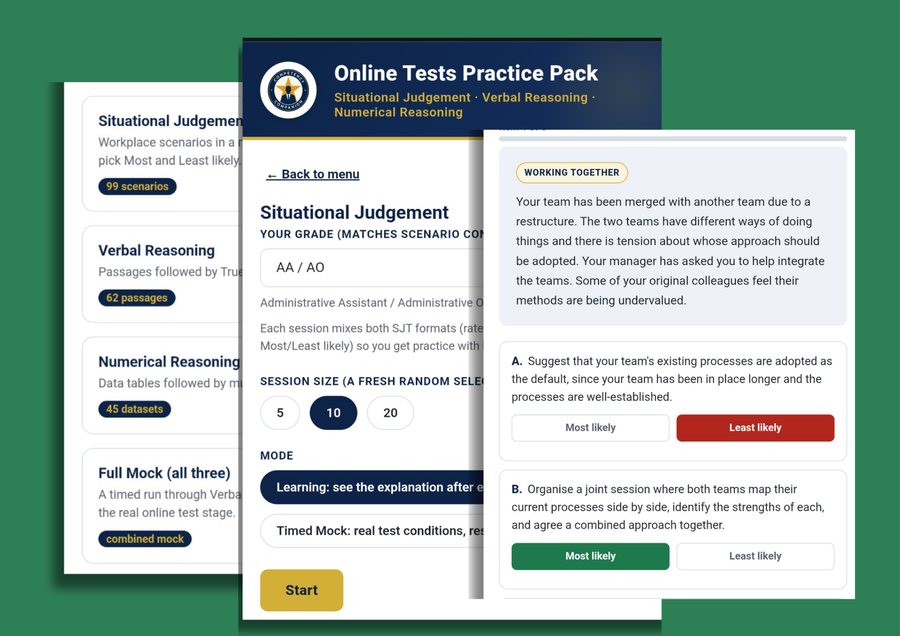
The best preparation is working through practice questions that use the same format as the real test: tables and charts of the kind found in government statistical publications. Pay particular attention to questions you get wrong. In most cases the error will not be the calculation itself but the step before it: reading the wrong figure from the table, misidentifying the unit, or misunderstanding what the question is asking.
After each practice session, go back through the questions you answered incorrectly and identify exactly where your reasoning went wrong. Was it the data reading, the calculation, or the interpretation of the question? Identifying your specific error pattern is far more useful than simply doing more questions.
What Comes After the Test
Passing the Numerical Reasoning Test moves you to the next stage, typically the sift, where your written competency or behaviour examples are assessed. This is where the majority of candidates are filtered out, and where thorough preparation pays the highest dividend.