If you have sat a Civil Service interview recently, you may have noticed something different. Instead of being asked one question per competency (“Tell me about a time you led a team,” followed by “Tell me about a time you managed a budget”), panels are increasingly asking fewer, broader questions where a single answer is expected to cover an entire cluster of competencies at once.
This is called cluster-based interviewing, and it is becoming the norm rather than the exception across NICS and the wider UK Civil Service. If you are still preparing example by example, one competency at a time, you may be under-prepared for what you will actually face in the room.
What Is a Competency Cluster?
Both the NICS Competency Framework and the UK Civil Service Success Profiles group their competencies into three broad clusters.
Setting Direction covers Seeing the Big Picture, Changing and Improving, and Making Effective Decisions. It is about your strategic awareness, your ability to think beyond your immediate role, and how you make evidence-based decisions. Panels use this cluster to assess whether you can operate at the level of the grade you are applying for.
Engaging People covers Leading and Communicating, Collaborating and Partnering, and Building Capability for All. It is about how you work with and through others: whether you can communicate clearly, build relationships across boundaries, and develop those around you, not just deliver results yourself.
Delivering Results covers Delivering Value for Money, Managing a Quality Service, Delivering at Pace, and Achieving Outcomes through Delivery Partners. It is about your operational effectiveness: how you get things done, manage resources, maintain quality, and work with external partners.
How Cluster-Based Questions Work
In a traditional interview, a panel member might spend the session rotating through individual competencies. In a cluster-based format, you might be told at the start: "We will ask you three questions today. Each question covers the entire Engaging People cluster; your answer should demonstrate all three competencies within it."
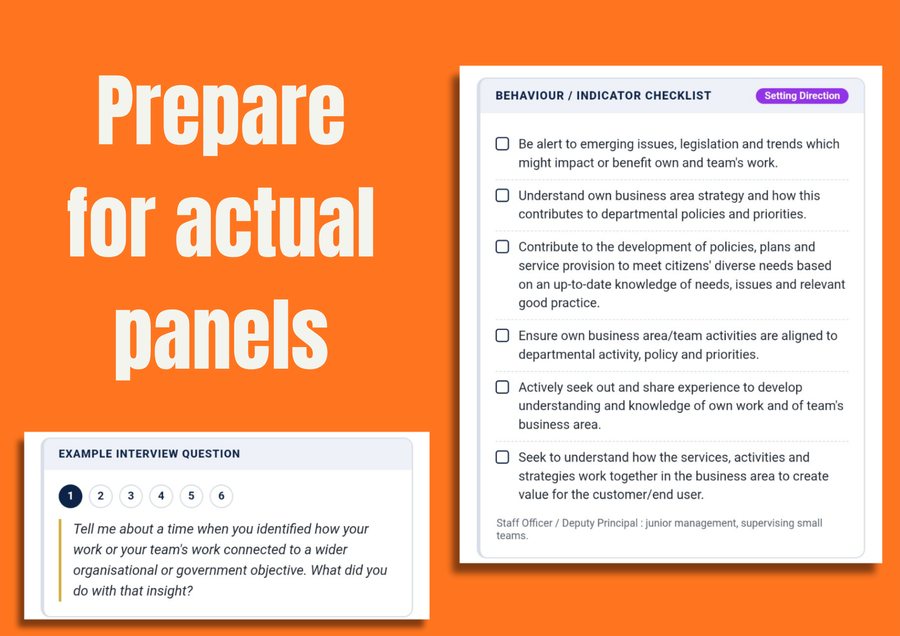
A typical cluster question sounds like this:
Notice what that question is doing. It is asking you to show Leading and Communicating, Collaborating and Partnering, and Building Capability for All, all within a single story.
The Threshold Rule: Why Partial Coverage Can Fail You Entirely
This is the part that catches candidates out most severely, and it is not widely understood.
In a cluster-based assessment, each competency within the cluster is typically marked separately. But many panels and assessment frameworks operate with a minimum coverage threshold: a floor below which a competency is considered not demonstrated at all, regardless of how well you performed on the others in the same cluster.
This is fundamentally different from a traditional interview where strong performance in one area can offset weaker performance in another. In cluster-based assessment, breadth is not optional; it is a requirement.
Think about what this means practically. A candidate who covers all three Engaging People competencies at a solid level will nearly always outscore and outplace a candidate who delivers an exceptional answer on one and says nothing about the other two. The floor matters as much as the ceiling.
Why One Rich Example Beats Three Thin Ones
You do not need a different story for each competency. You need stories that are rich enough to demonstrate all competencies in the cluster simultaneously, at a sufficient level across each one.
Think about it from the panel's perspective. They are not just checking boxes; they are trying to understand how you actually behave at work. A candidate who can tell one coherent story that naturally weaves together strategic thinking, clear communication, relationship building, and team development is far more impressive than one who produces three separate, disconnected anecdotes. More importantly, they are safer: they have met the threshold on all competencies rather than gambling that strength in one will carry weakness in another.
The Difference Between Single-Competency and Cluster-Ready Examples
Here is the same story written two ways. The first is written with a single competency in mind. The second is cluster-ready for the full Engaging People cluster.
"I was leading a project that required input from three different teams who had not worked together before. I arranged a series of joint workshops, actively sought input from all parties, and we agreed a shared delivery plan within six weeks."
That is a decent answer for Collaborating and Partnering. But it says nothing about how you communicated, and nothing about anyone's development. In a cluster interview, this answer risks falling below the threshold on the other two competencies and could fail the cluster entirely.
"I was leading a project that required input from three departments who had conflicting priorities and no shared working processes. Before any formal meetings, I proactively reached out to key stakeholders individually to understand their concerns and build trust. I then organised joint workshops where I deliberately sought input from frontline staff whose views had previously been overlooked, and I dealt with areas of conflict calmly and constructively until we reached shared goals everyone could commit to. Throughout, I tailored my communication style to each audience: formal written updates for senior stakeholders, informal check-ins for operational teams. I also used the project as a deliberate development opportunity: I gave a less experienced colleague responsibility for facilitating two of the workshops, coaching them beforehand and giving structured feedback afterwards. The three departments agreed a joint delivery plan within six weeks, the service launched on time, and the colleague I had developed went on to lead a similar workstream independently six months later."
That second version covers all three Engaging People competencies in one story. It meets the threshold on each one, which is the requirement, and tells a coherent, credible narrative at the same time.
How to Check Your Own Cluster Coverage
The challenge with cluster preparation is knowing whether your example genuinely covers the full cluster at a meaningful level, or whether it just covers one part of it well. Most candidates think they have covered a cluster when they have really only addressed the competency they had in mind when they wrote it.
A useful self-check: after drafting your story, go through each competency in the cluster and ask yourself: would a panel member reading this be able to identify and mark specific evidence for this competency? Not just "yes it touches on it" but "yes there is enough here to score it." If the answer for any competency is no or uncertain, that is the gap you need to fill before interview day.
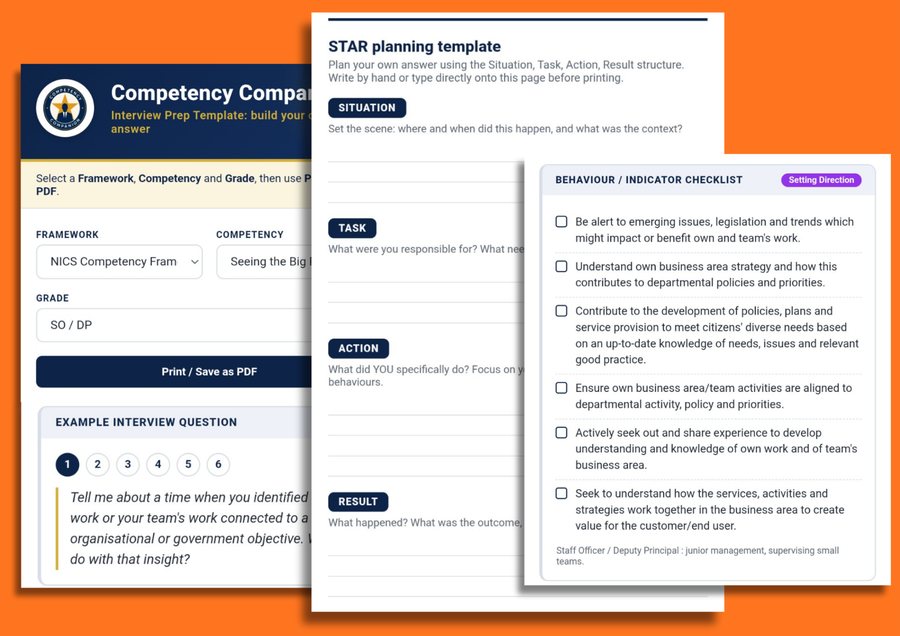
After analysing your example, switch to Cluster View (Premium) on the scorecard. This shows your score per competency within the cluster, which indicators you have hit and missed, and an aggregate cluster score. An example scoring 90% on one competency but 15% on another is flagging exactly the threshold risk described above. Use Smart Refiner on the weak competency to strengthen your coverage, then re-analyse to confirm you have lifted every competency to a meaningful level before the interview.
Building a Cluster-Ready Story Bank
Rather than preparing one example per competency (which means up to ten stories for NICS), the cluster approach lets you prepare fewer, richer stories that each cover an entire cluster.
A practical approach:
- Identify your three or four strongest real-world stories the ones where you had genuine impact and played a significant personal role.
- Map each story to its strongest cluster which cluster does it most naturally demonstrate?
- Enrich each story deliberately look at the indicators for every competency in that cluster. Where did you also demonstrate those behaviours? Add genuine elements that show it.
- Apply the threshold test to each competency not just "does my story touch on this?" but "is there enough here to be clearly evidenced and marked?"
- Check your aggregate cluster coverage use Cluster View to confirm you have meaningful evidence across all competencies, not just the headline one.
What the Panel Is Actually Marking
Each competency in the cluster typically has its own mark. Missing one does not lose you all marks, but it does mean you risk falling below the threshold on that competency, which in a cluster-based format can have consequences for the cluster as a whole.
Panels are also trained to look for breadth of evidence. An answer that clearly evidences all competencies at a solid level will almost always outscore one that goes very deep on one but says little about the others, even if the deep answer on that single competency is objectively impressive. The marking structure is designed to reward coverage, not just excellence in a single area.
A Note on Frameworks
NICS (Northern Ireland Civil Service): The NICS framework explicitly organises its ten competencies into Setting Direction, Engaging People, and Delivering Results. Cluster-based interviews at NICS level are increasingly common at SO/DP grade and above, with panels often designating which cluster each question covers at the start of the session.
UK Civil Service Success Profiles: The Behaviours within Success Profiles similarly group into strategic, people, and delivery clusters. At Grade 7 and above, interview structures frequently use cluster-based questions, and the same preparation principles apply.
The Short Version
Civil Service interviews are evolving. Cluster-based questions are becoming the standard, particularly at more senior grades. The candidates who perform best are not the ones with the most examples; they are the ones whose examples are rich enough to demonstrate a full cluster of behaviours in a single, coherent story, with sufficient evidence on every competency to clear the threshold.
Prepare fewer stories, but prepare them better. Know which cluster each story belongs to. Check your coverage across every competency in that cluster, not just the one you originally wrote it for. And go into the room confident that your story meets the bar on all competencies, not just excels on one.